


Despite changing shopping patterns, Black Friday remains a massive day for retailers, though it has become just one part of an expanded season of retail deals.
“Adobe expects U.S. online sales to hit $275.1 billion this holiday season (Nov. 1 to Dec. 31, 2026), growing 6.7% year-over-year (YoY). Cyber Week (the five-day period between Thanksgiving and Cyber Monday) is set to drive $47.5 billion online (up 7.4% YoY), representing 17.3% of the full holiday season spend,” according to Adobe’s 2026 forecast.
A lot of those sales, however, will be online.
“Cyber Monday (Nov. 30) is expected to set a new milestone for U.S. e-commerce, with consumers spending over $15 billion online in a single day ($15.1 billion, up 6.2% YoY). The second biggest day of the season will be Black Friday ($12.9 billion, up 9.2% YoY), which is growing faster than Cyber Monday — driven in part by having the biggest discounts for categories such as TVs, apparel, and appliances,” according to Adobe’s analysis.
It’s a long holiday season, and there are better days than others to buy certain items.
Shutterstock
When to buy what during Thanksgiving shopping season
Black Friday is Nov. 27 and Cyber Monday is Nov. 30.
Adobe’s data showed that there are better days than others to buy certain items.
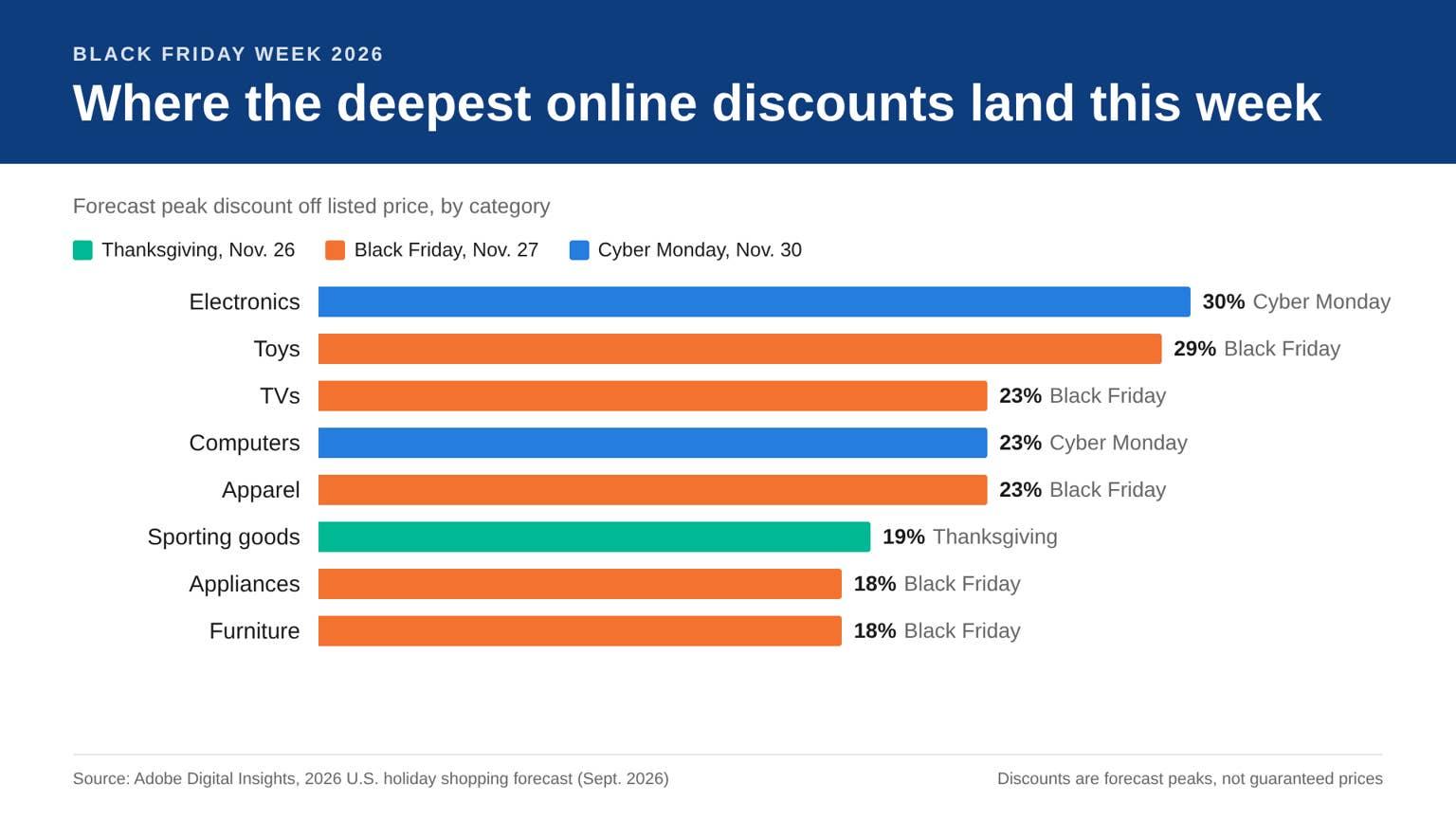
- Black Friday: Best for TVs, toys, apparel, appliances, and furniture.
- Cyber Monday: Best for electronics and computers.
- Thanksgiving Day: Best for sporting goods.
- Peak discounts: About 30% on electronics, 29% on toys, and 23% on TVs, computers, and apparel.
Some shoppers are also buying things they need rather than just things they want.
“While consumers have historically embraced holiday deals to buy gifts or adopt the latest gadgets, many are taking advantage of discounts to stock up on essentials. During Cyber Week, online sales of personal hygiene products are expected to jump 150% (compared to average sales levels in September 2026) and clothing basics by 210%. Other essentials set to see a boost include baby products (up 113%), pet products (up 93%), and household cleaning items (up 49%),” Adobe reported.
Also Read: Struggling home goods chain closing more stores
Shutterstock
Are there any products to avoid during the Black Friday season?
As a former retailer who ran a large independent toy store, I’d suggest either buying traditional stocking stuffers well before the season, or filling stockings with practical items. Something like Play-Doh or a mini Magic 8-Ball generally costs more at my former store during the holiday season.
The same might also be true for staples like decks of cards, Hot Wheels, and small games.
There are also some categories to avoid this time of year, according to NBC Select:
- Winter clothes and shoes: Wait until end-of-season clearance sales in January and February
- Mattresses, furniture, and major home and kitchen appliances: Wait until three-day holiday weekend sales like Presidents’ Day
- Bed and bath linens, like sheets and towels: Wait until “white sales” in January and three-day holiday weekend sales like Presidents’ Day
- Fitness equipment: Wait until New Year’s sales in January.
- Holiday decor: Wait until after the holiday season to refresh your collection and save it for next year.
ALSO READ: Walmart has a new plan to solve one of its customers’ biggest problems
Holiday gift scams to watch for
Back when I ran the toy store, a few days after Christmas, we would have customers bringing in train sets for us to repair. They were a brand we sold, but a lower-quality version sold in mall kiosks, or sometimes even in pop-up tents in parking lots.
The manufacturer essentially put its name on a low-quality product that its actual dealers could not repair. That left a lot of people angry at us, but when our entry-level train set started around $299, and you bought one for $100, you probably should have known there was a catch.
RILA Communities Foundation shared with TheStreet some other common scams to watch out for:
- Gift Card Scams: Scammers love gift cards because once you share the card number and PIN, your money can be gone in seconds. Never let anyone pressure you into buying a gift card or sharing the information on the back of the card.
- Counterfeits: Counterfeiters know holiday shoppers are looking for a great deal, and they use steep discounts, convincing photos, and look-alike websites to lure consumers into buying fake and sometimes dangerous products. Before you buy, take a closer look at who is actually selling the item, check the seller’s history and reviews, and be suspicious of prices that are dramatically lower than you would expect. Watch for misspelled brand names, poor-quality images, unusual packaging, vague product descriptions, and websites or sellers you don’t recognize.
- Stolen products: Beware of online sellers with little or no verifiable history and prices that are substantially lower than those offered by established retailers can indicate stolen products being resold. This is a known tactic for organized retail crime rings. A low price may be legitimate, but consumers should independently verify the seller before making a purchase. Be especially cautious when a seller pressures you to pay through a wire transfer, cryptocurrency, gift card, or other payment method that may offer limited protection.
Scammers also set up fake gift-card balance-checking websites to capture card numbers and PINs. Check a balance through the website or phone number printed on the card, not through a link in a search result, ad, text, or email.
“More than one-third of consumers say they have experienced at least one holiday scam tactic in recent years,” according to data shared with TheStreet by Bank of America.
Scammers are also using artificial intelligence to make fake retailer and delivery-service websites look convincing. Check the seller’s history and contact details, avoid links in unsolicited messages, and contact your bank immediately if you believe your financial information has been compromised.